

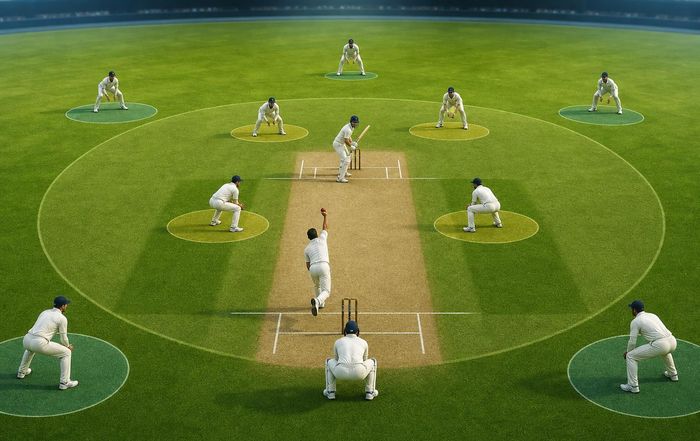
Cricket Fielding Positions And What Each Role Really Demands
Fielding is often described as the "third discipline" of cricket after batting and bowling, but at elite level it is woven into every ball of the game. Modern teams pick players not just for how many runs they score or wickets they take, but for how much ground they cover, how sharp their hands are, and how well they understand angles, spin and match situations. To understand that properly, it helps to break down the field not just as a collection of dots on a diagram, but as a set of roles with specific physical, technical and mental demands. This sports education content walks through the main fielding positions in cricket, explains where they are on the ground, and focuses on what each role really asks of a player across Test, ODI and T20 formats.
Reading a field: how positions are named and organised
Before looking at individual roles, it is worth decoding the language. Fielding positions are traditionally described in relation to the batter, the wicket and the line from mid-off to mid-on.
The field is divided into off side and leg (or on) side, with the batter's stance as the reference. For a right-hander, off side is to the right when looking down the pitch; for a left-hander, it flips. Positions are then modified by distance (short, silly, mid, deep), angle (square, fine, backward, forward), and whether they are closer to straight (mid-off/mid-on) or squarer (point, square leg). Umpires, coaches and analysts at bodies such as the International Cricket Council (icc-cricket.com) and national boards like the England and Wales Cricket Board (ecb.co.uk) use the same shared vocabulary, which helps when comparing tactics across formats and conditions.
From a performance point of view, this vocabulary also maps loosely to the types of athlete teams want in each zone: explosive sprinters patrolling the deep, reflex specialists close to the bat, and reliable all-rounders in the ring. Data-heavy competitions such as the Indian Premier League, covered extensively by outlets like https://www.espncricinfo.com/, have only sharpened that specialisation.
For readers looking to connect this positional nuance to broader sport science, our sections on sports and science often explore how biomechanics, decision-making and data tracking influence performance in the field.
Slip cordon and keeper: reflexes, reading edges and concentration
The slip cordon and wicketkeeper form the primary catching channel behind the bat. They are most prominent in Test and first-class cricket, but still matter in white-ball formats, especially early with a new ball.
The wicketkeeper is effectively a specialist position, combining elements of a catcher, infield general and part-time psychologist. At elite level, keepers must have exceptional hand-eye coordination, low-back and core strength to endure long hours in a crouch, and the ability to move explosively laterally for takes down the leg side. They are involved in almost every delivery, so their concentration demands are higher than for any other fielder. Governing bodies such as Cricket Australia (cricket.com.au) and the Board of Control for Cricket in India (bcci.tv) have invested heavily in specialist wicketkeeping coaching, reflecting how much influence the role has on dismissals and team energy.
Slips-first, second, third and sometimes beyond-stand in an arc to the keeper's off side (for an orthodox right-arm bowler to a right-hand batter). Their job is to intercept thick and thin edges that fly quickly at chest or head height. The closer they stand, the less reaction time they have, which is why slips are often senior batters with proven hands and strong anticipation. Technically, they must stay low, keep their weight on the balls of their feet and "soft hands" ready to absorb impact. Mentally, slip fielders need to handle long quiet spells punctuated by split-second chances; lapses in concentration are costly. In many Test sides, the slip cordon is a semi-fixed group that trains together, building trust and understanding of each other's territory.
In limited-overs cricket, slips are used more sparingly, but in early overs or on seaming pitches they remain critical. Analysts using tracking and performance data-something explored in more detail in our technology coverage-help captains decide when the risk-reward balance justifies keeping a slip in place versus pushing that player into the ring or out to the boundary.
Close catchers: short leg, silly point and bat-pad specialists
Positions like short leg, silly point and leg gully sit within a few metres of the bat, mostly in red-ball cricket against spin or aggressive short-pitched fast bowling. Their job is to capitalise on bat-pad deflections, miscued drives and hurried pulls before the ball can bounce.
Physically, these are among the most demanding and dangerous roles. Fielders wear extra protection-helmets with grills, chest guards, shin guards, sometimes even forearm padding-yet still face real risk of impact injuries. Research into head safety and concussion from bodies such as Cricket South Africa (cricket.co.za) and independent groups highlighted by organisations like Headway in the UK (headway.org.uk) has led to stronger helmet standards and more conservative protocols, but bravery and commitment remain non-negotiable traits for close catchers.
Technically, these fielders must stay very low, often in a semi-squat, tracking the bowler's hand, reading the batter's trigger movements and watching the ball all the way off the pitch. Their catching technique emphasises soft, cupped hands and minimal flinch reaction. They also play a tactical role: their mere presence can make a batter less confident playing forward, especially against spin, which can shift the balance of a session. Captains often use young, agile players here, but the very best close catchers-such as those celebrated in long-form analysis on sites like https://www.bbc.com/-combine athleticism with very sophisticated anticipation.
For those interested in the broader health and safety side of elite sport, our health and environment sections also explore how equipment standards and playing conditions evolve in response to medical research and climate.
The infield ring: point, cover, mid-off, mid-on and midwicket
In limited-overs cricket, the "ring" between roughly 15 and 30 metres from the bat often decides whether a total is par, below, or above expectation. Positions like point, cover, extra cover, mid-off, mid-on, midwicket and square leg form a semicircle where ground-fielding, throwing and anticipation are at a premium.
The modern point fielder-especially in T20-is usually one of the most athletic players in the side. They must move laterally at high speed to cut off square cuts and back-foot punches, dive both ways, and recover quickly to throw at the stumps. A powerful, accurate flat throw from point can turn a comfortable single into a run-out chance. Training programmes developed by high-performance units, such as those under New Zealand Cricket (nzc.nz), emphasise repeat sprint ability, sliding technique and joint robustness for these roles.
Cover and extra cover combine similar athletic demands with strong tactical awareness. These fielders often work closely with the captain and bowler, adjusting their depth ball by ball based on length, batter intent and match situation. They need soft hands for low catches, safe technique for half-volleys drilled at them, and composure under pressure because many of their chances come in powerplays or at the death when every run matters. Mid-off and mid-on, by contrast, are often home to senior players or even the captain, because they have a direct line of communication to the bowler and can see the full field. They act as traffic controllers, relaying plans, adjusting angles and reminding teammates of fielding positions between balls.
From a physical standpoint, ring fielders must be able to accelerate explosively over 5-15 metres, change direction repeatedly and get up from dives quickly. Sport-science research on agility and change-of-direction, some of which is summarised by organisations like the Australian Institute of Sport (ausport.gov.au), has influenced how teams design their fielding drills: more game-like, with decision-making layered on top of conditioning. For readers interested in how this overlaps with broader fitness trends, our fitness coverage often touches on similar movement-quality and injury-prevention themes.
Boundary riders: deep cover, long-off, long-on and deep midwicket
In white-ball cricket, particularly T20, boundary fielders are as central to strategy as death bowlers. Positions such as deep cover, deep extra cover, long-off, long-on, deep midwicket and deep square leg are tasked with preventing fours and sixes, cutting off twos, and executing high-pressure catches.
The physical demands here are dominated by repeated high-speed sprints over 20-40 metres, often from a static or side-on start, plus the ability to judge and complete catches while running at full tilt. Many of the spectacular moments that circulate on social media-relay catches, boundary-line tip-backs, acrobatic dives-come from these positions. That visibility has changed how coaches at professional franchises and national teams approach fielding recruitment: outfield excellence is now a core selection metric, not an optional bonus. Data-driven leagues, often analysed by business and sports-tech outlets such as https://www.forbes.com/ and https://www.theathletic.com/, quantify saved runs and catching difficulty, influencing contracts and roles.
Technically, boundary riders must master several skills. They need safe, high-catch technique under lights and in variable wind; an understanding of their own and teammates' range to decide when to attempt a catch versus parry back infield; and strong, accurate throwing mechanics to hit the keeper or bowler's end from the rope. Many teams assign their best arms to long-off and long-on, where throws to both ends are common. Decision-making under pressure is central: knowing when to attack the ball to prevent two, when to hang back to avoid conceding a boundary, and when to attempt the spectacular catch versus ensuring the single.
Boundary positioning also reflects opposition analysis. Against a power-hitter who favours the leg side, captains might post deep midwicket and deep square leg, while leaving deep cover vacant and trusting slower bowlers to change pace. Our business and news sections frequently cover how analytics teams use video and ball-tracking data to inform such micro-tactics, which in turn change the skillsets franchises seek in their outfielders.
Sweeper and third man: angles, touch and damage limitation
Two positions that often look passive to casual viewers-but are vital in modern cricket-are third man (or fly slip) and the sweeper on either side. Third man is located behind point on the boundary, while sweepers operate roughly between cover and mid-off on the off side, or between square leg and midwicket on the leg side.
Third man's primary job in pace bowling is to intercept edged or guided shots past the slips and gully, and to cover the angle from back-of-a-length bowling outside off. In death overs, third man might be brought up or pushed back depending on whether the bowler plans to go full and straight, wide yorker, or short. The role demands excellent reading of angles, because a few steps left or right before the ball is hit can be the difference between a single and a boundary. Fielders here often need a reliable throw and good decision-making on whether to attack the ball or play safe, particularly on big grounds where conceding two can be acceptable but four is costly.
Sweepers are more prominent against spin, especially in limited-overs cricket where captains prefer to protect the boundary and concede singles. A sweeper must cover a wide arc, anticipate whether the batter is more likely to slog-sweep, reverse-sweep or loft inside-out over cover, and adjust their starting position accordingly. Fitness demands are high: repeated long sprints, constant small adjustments, and lots of bending and throwing. Technically, sweepers practice collecting balls on the half-volley, sliding safely on hard outfields, and throwing accurately off both sides when off-balance.
Because these roles are heavily informed by match-ups and data, they illustrate how modern fielding is increasingly analytical. High-performance departments, sometimes in collaboration with external analytics firms and academic partners such as Loughborough University (lboro.ac.uk), model shot charts and expected runs to decide optimal sweeper and third-man placements. That interplay between data and on-field instinct is a recurring theme in contemporary sports science and is often mirrored in other sports we cover, from football pressing schemes to baseball defensive shifts.
Specialist positions: gully, leg slip, fly slip and short third
Some fielding positions appear only in specific tactical contexts but carry distinct demands. Gully, for instance, sits between point and the slips, often for fast bowlers targeting the corridor outside off. It requires similar reflexes and catching technique to the slips but with more lateral movement, because the ball can arrive at different heights and angles. Gully fielders must also be agile enough to cut off late cuts and dabbed shots, especially in limited-overs cricket when batters exploit gaps behind point.
Leg slip and short fine leg come into play mostly against fast bowlers using bouncers or against batters who glance and flick off their pads. These positions demand courage and quick reactions, as the ball can be deflected sharply at awkward heights. They also require excellent anticipation, because the fielder has a reduced visual window once the ball passes the batter's body. Captains often use them as surprise attacking options in Tests, trusting specialist close catchers to seize rare chances.
Fly slip-a deeper, wider version of third slip or gully-is sometimes used in T20 or ODI powerplays to catch top-edged slashes from batters trying to hit over point. Fielders here need to be strong in overhead catching and comfortable running back with the flight, a notoriously difficult skill. They also act as a safety net for misjudged dives from inner ring fielders.
These specialist roles show how flexible modern fielders must be. Few players are permanently assigned to gully or leg slip; instead, they rotate based on bowling plans and match conditions. That adaptability is nurtured in professional pathways, from age-group academies to franchise leagues, where young players are taught the full map of positions and drilled in multiple roles-an area often discussed in coaching and talent-development content from organisations like The Coaching Association of India and regional equivalents highlighted by World Players' Union FIFPRO (fifpro.org) when they speak about athlete workloads and skills.
Captains, communication and fielding as a system
While it is useful to break positions down individually, fielding only really makes sense as a system. A captain's choice to move cover five metres squarer affects the value of point; pulling mid-on back to long-on changes how midwicket must defend the single. Good fielders understand not just their own role, but how it meshes with those around them.
Communication is therefore a core demand of almost every position. Mid-off and mid-on relay messages to the bowler and adjust the ring; boundary riders signal wind direction or dew on the ball; the keeper and slips provide feedback on swing, seam and batter intent. In noisy stadiums, especially in franchise T20 leagues, hand signals and pre-agreed codes become essential tools. Teams that invest in clear communication protocols and leadership development-topics frequently covered in our social and world sections when they intersect with sport-tend to make fewer positioning errors under pressure.
Fielding also reflects culture. Sides like New Zealand, Australia and South Africa have long emphasised fielding intensity as part of their identity, while emerging nations have invested in specialist fielding coaches to close the gap. Governing bodies and think-tanks, including the Marylebone Cricket Club (lords.org), have highlighted in their coaching resources how a strong fielding culture can compensate for deficiencies elsewhere, particularly in youth and associate cricket.
Training for the demands of each role
Although most professional cricketers are expected to be competent in multiple positions, high-performance programmes increasingly tailor training to likely roles. Close catchers spend more time on reaction drills with deflection boards and hard-ball simulations; slip fielders work on hundreds of catches a week, often with wet or new balls to mimic match conditions; boundary riders practise high catches under floodlights and long throws with GPS-tracked workloads to manage shoulder stress.
Strength and conditioning coaches, drawing on wider sports-science research from institutions such as FIFA's medical centre or Olympic high-performance hubs, incorporate sprint work, plyometrics, core stability and mobility to prepare athletes for the acceleration, deceleration and diving loads of fielding. Recovery and injury-prevention strategies-particularly for shoulders, knees and lower backs-are now standard parts of professional setups. These themes often crossover with broader performance discussions in our sports and health coverage, where we look at how training methodologies evolve across different codes.
At amateur level, understanding what each position demands can help teams place players more intelligently. A club side might not have eleven elite athletes, but it can put its safest hands in slip, its quickest sprinter at point, its strongest thrower at long-off, and its bravest all-rounder at short leg when needed. Even modest improvements in alignment between role and skillset can translate into fewer boundaries conceded and more chances taken.
Why fielding positions matter more than ever
As scoring rates continue to climb in international and franchise cricket, and as data exposes exactly how many runs are saved or lost in the field, the value of each position has become more quantifiable. Analysts can now show that a boundary saved at deep midwicket in the 8th over of a T20 is statistically as important as a dot ball at the death, or that a slip catch early in a Test innings shifts win probabilities significantly. That evidence has changed how coaches talk about fielding in contract negotiations, how broadcasters analyse games, and how young players prioritise their development.
For players and fans alike, understanding what each fielding position demands-physically, technically and mentally-adds a layer of appreciation to every ball. The next time a captain shuffles point squarer, pushes long-on back, or sneaks a leg slip in, it is not just a matter of filling space; it is a calculated bet on where the next moment of impact will occur, and on which fielder has the skills and temperament to turn that moment into an advantage.