

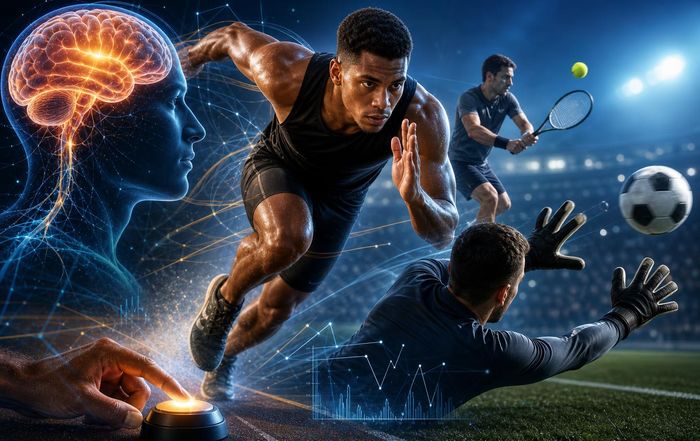
The Science of Reaction Time in Competitive Sports
In elite sport, the difference between victory and defeat is often measured in fractions of a second. A goalkeeper diving for a penalty, a batter reading a fastball, a sprinter leaving the blocks, or an esports pro landing a critical shot all rely on one underlying capacity: reaction time. Yet "quick reactions" are not just about being born fast. They emerge from a complex interaction of brain processing, sensory systems, biomechanics, training, fatigue, and even pressure.
This sporty article unpacks what scientists mean by reaction time, how it is measured, which factors shape it, and how athletes and coaches can train it more intelligently. It also looks at how different sports demand different types of reactions, and why the fastest raw reaction time does not always win.
What reaction time actually is (and isn't)
In sports science, reaction time is typically defined as the interval between the onset of a stimulus and the initiation of a response. The stimulus might be a starter's gun, a visual cue from an opponent, a ball leaving a racket, or even a haptic vibration in esports. The response is the first detectable movement: a finger twitch on a trigger, a muscle activation in the legs, or a head turn toward the ball.
Researchers often separate this into two related but distinct components:
Reaction time (RT): How long it takes to perceive and process the stimulus and send a command from the brain to the muscles.
Movement time (MT): How long it takes to execute the movement once it has been initiated.
Total performance in sport usually depends on response time, which is RT + MT. For example, in a 100m sprint, the athlete's reaction to the gun is RT, and the time to drive out of the blocks is MT. In many real-world situations, decision-making is also involved, so scientists talk about choice reaction time, where the brain must select among multiple possible responses, rather than a simple automatic one.
Neuroscientists map this process along a pathway: sensory receptors (eyes, ears) detect a signal, information travels via peripheral nerves to the spinal cord and brain, cortical and subcortical regions interpret the input and choose a response, then motor commands travel back down to the muscles. Studies using electroencephalography and brain imaging from institutions such as Harvard Medical School and University College London have shown that even a "simple" reaction involves a distributed network, including the visual cortex, parietal areas for spatial processing, and motor regions that plan movement. This makes clear that reaction time is not just about "fast muscles"; it is fundamentally a brain performance issue.
How reaction time is measured in sport science
Sport scientists and performance labs use a mix of laboratory tests and field-based protocols to measure reaction time. In controlled settings, athletes might sit at a computer and respond to lights or sounds by pressing a key or clicking a mouse. These simple reaction time tests, used widely in cognitive research by organizations like the National Institutes of Health at https://www.nih.gov/, can quantify baseline neural speed with millisecond precision.
However, competitive sport rarely involves a single, isolated stimulus. To capture more realistic performance, researchers use choice and discrimination tasks, such as responding differently to red versus green lights or to a ball moving in different directions. Tools like the Psychomotor Vigilance Task (PVT), used by sleep scientists at places like NASA (https://www.nasa.gov/), assess how fatigue affects reaction over time, something very relevant to long tournaments and late-night matches.
In applied sport settings, coaches layer reaction measurements into sport-specific drills. For example:
Tennis players react to ball machines or live serves while motion capture records the onset of movement.
Goalkeepers respond to randomized shots or light systems placed around the goal.
Combat athletes react to feints and strikes tracked by wearable sensors.
Esports and gaming athletes use standardized aim trainers and latency-controlled setups.
These field tests capture not only raw RT but also how athletes integrate reaction with technique, decision-making and movement patterns. For readers interested in how this overlaps with broader performance metrics, SportSyncr's own sports and fitness coverage regularly explores how teams and athletes adopt testing technology.
Neural processing: from stimulus to decision
The time between stimulus and response is shaped by several neural stages. First, sensory encoding: photoreceptors in the eyes or hair cells in the ears convert physical signals into electrical impulses. The speed and fidelity of this step depend on the quality of the stimulus (brightness, contrast, loudness) and the health of the sensory system. For example, high-contrast visual cues tend to produce faster RTs than low-contrast ones, which is one reason many sports use bright balls and clear lines.
Next comes perceptual processing and interpretation. The brain must recognize what the stimulus is, where it is, and whether it is relevant. Visual information flows from the retina to the lateral geniculate nucleus and then to the primary visual cortex, where features like orientation and motion are extracted. Higher-level areas integrate this into meaningful patterns-"that's a curveball," "that's a fake pass," or "that's the starting light." Research in journals such as Current Biology and Journal of Neuroscience, often highlighted by outlets like https://www.nature.com/, shows that expert athletes develop more efficient neural representations of sport-specific patterns, allowing them to recognize situations faster.
Then comes decision and response selection, which is where expertise really shows. In many sports, the athlete is not just reacting to a single cue but choosing among multiple options: swing or hold, tackle or jockey, shoot or pass. This choice reaction time is influenced by factors such as the number of options, their similarity, and the athlete's prior experience. Cognitive psychologists often refer to Hick's Law, which states that reaction time increases logarithmically as the number of choices increases. Elite performers, however, can partially bypass this limitation by using anticipation and pattern recognition to narrow the options before the stimulus fully unfolds.
Finally, motor planning and execution translate the decision into action. The premotor and motor cortices specify which muscles to activate and in what sequence, while the cerebellum fine-tunes timing and coordination. Motor commands travel via the corticospinal tract to the spinal cord and then to the muscles. The speed of nerve conduction, synaptic efficiency, and muscle fiber properties all influence how quickly movement begins. This is where neuromuscular conditioning, strength training, and coordination work-topics frequently covered in our health and fitness sections-become critical.
Simple vs. complex reaction time in real sports
In controlled experiments, healthy adults often show simple visual reaction times around 200-250 milliseconds and auditory reaction times around 150-200 ms, with variations depending on age, fatigue, and testing methods. But most competitive sports rarely involve such simple conditions. The more complex and uncertain the environment, the more important perception, anticipation, and decision speed become relative to raw neural conduction.
For instance, a sprinter in the starting blocks faces a relatively simple task: respond as quickly as possible to a single auditory cue. Modern timing systems in athletics, governed by bodies like World Athletics at https://worldathletics.org/, even set thresholds (such as 0.1 seconds) below which a start is considered a false start, on the assumption that humans cannot legitimately react faster than this to a gun. Here, training focuses heavily on optimizing that specific auditory reaction and the transition into explosive movement.
By contrast, a tennis returner or baseball batter faces a complex, fast-moving scene. They must read the opponent's body language, racket or arm angle, ball trajectory and spin, and contextual information like score and previous patterns. Studies of elite hitters, including work supported by organizations like Major League Baseball at https://www.mlb.com/, suggest that they begin to commit to a swing decision well before the ball reaches halfway to the plate, relying heavily on anticipatory cues. In such contexts, the most successful athletes are not necessarily those with the fastest lab-measured reaction times, but those who can predict and filter information to reduce the decision space before the ball is even released.
Team sports such as football, basketball, and hockey add another layer: tactical context. Players constantly react not only to the ball or puck but also to teammates, opponents, and space. Their "reaction time" includes reading patterns like overlaps, screens, and rotations. This is why cognitive training, video analysis and game intelligence-topics that intersect with culture and business in modern analytics-driven sport-have become major areas of investment.
Factors that influence reaction time
Reaction time is highly individual and dynamic. Several key factors influence it, many of which can be modified with training and lifestyle.
Age and development. Reaction times generally improve from childhood through adolescence as the nervous system matures, peaking in early adulthood and then gradually slowing with age. Large-scale cognitive studies, including those promoted by the American Psychological Association at https://www.apa.org/, show a U-shaped curve: children and older adults tend to react more slowly than young adults. However, experienced older athletes can compensate for some slowing through better anticipation and positioning.
Arousal and stress. There is a well-known inverted-U relationship between arousal and performance, often associated with the Yerkes-Dodson law. Too little arousal (sleepiness, boredom) slows reactions; too much (anxiety, panic) can cause freezing, impulsive errors, or false starts. Elite athletes work with sport psychologists, sometimes guided by organizations like the International Society of Sport Psychology at https://www.issponline.org/, to regulate arousal through breathing, routines, and mental skills.
Fatigue and sleep. Sleep loss, jet lag, and cumulative fatigue all impair reaction time and decision-making. Research by groups such as the National Sleep Foundation at https://www.thensf.org/ and space agencies like NASA has consistently shown slower RTs and more lapses under sleep restriction. For sports with congested schedules or heavy travel, managing sleep becomes a competitive advantage, intersecting directly with athlete health and recovery practices.
Attention and focus. Divided attention, distractions, or mind wandering can delay reaction. In environments like esports, motorsport, or goalkeeper play, where multiple stimuli compete for attention, training often includes attentional control and situational awareness drills. Cognitive load from complex tactics or unfamiliar situations can also lengthen choice reaction time.
Sensory quality and equipment. Poor lighting, visual clutter, or low-contrast uniforms can make it harder to pick up key cues. Governing bodies and broadcasters increasingly consider visibility and color contrast-issues that overlap with technology and brands-to improve both fairness and fan experience. Equipment choices, such as racket string tension or stick flex, can also influence the time window athletes have to react.
Physiological state and health. Dehydration, low blood sugar, some medications, and neurological conditions can all slow reaction time. On the positive side, moderate aerobic fitness and regular exercise are associated with better cognitive speed, as documented by bodies like the World Health Organization at https://www.who.int/. This reinforces the idea that general conditioning, not just sport-specific drills, underpins sharp reactions.
Can reaction time be trained?
One of the most important questions for coaches and athletes is how much reaction time can actually be improved. Genetics and early development clearly play a role, but research suggests that targeted training can produce meaningful gains, especially in the components that matter most in sport: anticipation, decision-making, and sport-specific responses.
Traditional drills often focus on simple reaction tasks: responding to a coach's clap, a colored cone, or a ball dropped without warning. While these can sharpen basic alertness and reduce motor hesitancy, they only loosely resemble the rich, information-dense environments of real competition. More sophisticated approaches include:
Perceptual-cognitive training, where athletes practice reading game situations from video or virtual reality, pausing before the key moment and predicting what will happen next. Companies working in this space often collaborate with clubs across football, basketball, and rugby, as covered in international outlets like https://www.bbc.com/.
Occlusion training, in which parts of an opponent's body or the ball trajectory are masked to force athletes to rely on earlier cues (for example, shoulder rotation or racket preparation). This improves anticipation rather than just raw speed.
Dual-task and pressure drills, which combine physical movement with decision-making under fatigue or time pressure, mirroring match conditions. For example, small-sided games where players must react to coach-imposed rules that change mid-play.
Beyond sport-specific work, neurocognitive training tools-from tablet apps to light-based systems-aim to improve processing speed, working memory, and visual search. Independent research is mixed: some studies show transfer to on-field performance, while others find improvements mostly confined to the trained tasks. Governing bodies and research institutions, including the International Olympic Committee at https://olympics.com/, have called for more rigorous, sport-specific trials before strong claims are made.
In practice, the most effective programs tend to integrate reaction training into technical and tactical work, rather than treating it as a separate add-on. For example, a basketball coach might design shooting drills where athletes must react to a defensive rotation or a late pass, rather than simply catching and shooting on a predictable rhythm.
Strength, speed, and the neuromuscular side of reaction
Even when the brain sends a fast signal, the body still has to execute it. Reaction time in sport is tightly coupled to explosive strength, coordination, and neuromuscular efficiency. This is especially evident in sprint starts, change-of-direction tasks, and combat sports.
Fast-twitch muscle fibers can contract more rapidly and generate force more quickly than slow-twitch fibers, giving athletes with a higher fast-twitch proportion a natural advantage in explosive movements. However, strength and conditioning programs, informed by research from institutions like the American College of Sports Medicine at https://www.acsm.org/, show that rate of force development can be significantly improved through targeted training, even if fiber-type distribution is partly genetic.
Plyometrics, Olympic lifting derivatives, resisted sprints and agility drills all aim to shorten the time between ground contact and force generation, a key element in practical response time. Coordination and technique also matter: a technically efficient sprinter or defender can translate a given neural signal into movement with fewer wasted motions and less internal friction.
Importantly, there is a distinction between starting speed and change-of-direction reaction. A sprinter in the blocks has a pre-set posture and known direction of force application. A defender reacting to a dribbler or a full-back adjusting to a cross must rapidly decelerate, reorient, and re-accelerate. Here, eccentric strength, joint stability, and proprioception (the body's sense of position) become crucial. These topics sit at the intersection of performance and injury prevention, areas we often explore in our health and science coverage.
Anticipation: why the "fastest" athlete doesn't always win
A central insight from decades of sports science is that anticipation often beats raw reaction speed. Elite performers learn to read cues so early and so accurately that they effectively start reacting before the obvious stimulus appears.
Goalkeepers, for example, rarely wait to see the full trajectory of a penalty before diving. They use the kicker's run-up angle, plant foot position, hip rotation, and historical tendencies to predict direction. Studies in football and handball, highlighted by organizations such as FIFA at https://www.fifa.com/, show that expert keepers fixate on specific body regions at key times, whereas novices look more diffusely and later in the movement.
Similarly, top batters and tennis players use pre-release cues like shoulder and arm motion to anticipate pitch type or serve direction. In combat sports, experts detect subtle weight shifts or shoulder movements that signal a strike before it is fully launched. In all these cases, the effective "reaction time" is reduced not by faster nerves but by earlier information.
This has practical implications for training. Rather than only trying to shave a few milliseconds off basic RT, coaches can gain more by teaching athletes what to look for, when, and how to interpret it. Video breakdown, opponent scouting, and live pattern-recognition drills become tools not just for tactics but for reaction optimization.
Technology, esports, and the digital frontier of reaction time
Reaction time is not just a concern for traditional physical sports. In esports and competitive gaming, where actions-per-minute and input precision are central, latency and cognitive speed are decisive. Pro players in titles like first-person shooters or real-time strategy games routinely demonstrate mouse-click reaction times in the 150-200 ms range under controlled conditions, though in-game performance also depends heavily on prediction, map knowledge, and team coordination.
Esports organizations and performance labs increasingly use reaction and aim trainers, eye-tracking systems, and custom hardware to measure and train responses. This intersects with broader technology conversations: network latency, monitor refresh rates, and input devices can all add or remove critical milliseconds between stimulus and action. The gaming world's focus on reaction dovetails with our gaming and technology coverage, where hardware choices and training tools are frequent topics.
The use of wearables and smart systems in traditional sports also continues to grow. Light-based training systems, instrumented reaction walls, and VR platforms promise to simulate match-like stimuli while recording millisecond-level data. While some of these tools are supported by solid validation studies, others remain ahead of the published science; independent evaluations by universities and institutes, often shared through outlets like https://www.espn.com/, are essential to distinguish marketing claims from measurable benefits.
Practical implications for athletes and coaches
For athletes at any level, understanding the science of reaction time can shape smarter training choices:
Prioritize sleep and recovery. Because fatigue and sleep loss reliably slow reaction time, consistent sleep routines, travel management, and workload monitoring may yield bigger gains than extra reaction drills alone. This connects directly to broader performance and health strategies.
Train sport-specific reactions. Integrate reaction demands into realistic scenarios: defenders reacting to live attackers, hitters facing varied pitches, keepers reading real shots. This builds the perceptual and decision components that lab tests often miss.
Develop anticipation skills. Use video, occlusion, and guided discovery to teach athletes which cues predict key events. This can effectively give them more time to react without changing their raw neural speed.
Balance cognitive and physical work. Combine reaction tasks with movement, fatigue, and tactical decision-making to reflect match conditions, rather than isolating them in sterile environments.
Use technology critically. Reaction apps and devices can be useful, but they should serve clear, sport-specific goals and be interpreted alongside other performance data, not treated as standalone proofs of improvement.
At the same time, coaches and practitioners should recognize individual differences. Some athletes may never test as the absolute fastest in simple reaction tasks yet still excel through anticipation, positioning, and game intelligence. Others may have exceptional raw speed but need help channeling it into effective decision-making under pressure.
Where reaction time research is heading
As neuroscience, biomechanics, and data analytics converge, reaction time in sport is being studied in increasingly fine detail. High-density EEG, functional MRI, and advanced motion capture allow researchers to map not only how fast athletes respond but which brain and body systems contribute at each stage. Machine learning models trained on large datasets from wearables and match footage aim to identify patterns of anticipation and decision-making that distinguish elite performers.
There is growing interest in how long-term training shapes brain structure and connectivity, with some studies suggesting that expert athletes show different patterns of white matter integrity and cortical thickness in regions involved in visuomotor control. Organizations like the National Collegiate Athletic Association (NCAA) at https://www.ncaa.org/ and professional leagues worldwide are also funding research on how concussions and repetitive head impacts affect reaction time and cognitive speed over time-an area where performance, safety, and world sport policy intersect.
At the same time, ethical questions are emerging around neuroenhancement. As brain stimulation techniques and pharmacological interventions develop, regulators and anti-doping agencies, including the World Anti-Doping Agency at https://www.wada-ama.org/, are considering how to treat methods that might artificially speed reaction or decision-making. The line between legitimate cognitive training and unfair enhancement is likely to be debated more intensely in the coming years.
Reaction time in competitive sports is far more than a single number on a stopwatch. It is a composite of neural processing speed, perceptual skill, anticipation, decision-making, and physical execution, all shaped by training, health, technology, and context. Understanding these layers helps explain why some athletes seem to operate "a step ahead" and offers practical pathways for players and coaches looking to sharpen their edge-whether on the track, in the arena, or behind a screen.