

How Sports Influence Modern Urban Development
The New Playbook for Cities: Sports as a Strategic Urban Asset
Sports have evolved far beyond entertainment and recreation; they have become a strategic lever for shaping how cities grow, compete, and define themselves on the global stage. From London to Los Angeles, Singapore to São Paulo, mayors, planners, investors, and community leaders increasingly treat sports infrastructure and culture as core components of urban development strategies, rather than as peripheral amenities. On Sportsyncr and across the broader ecosystem of sports-focused media, this shift is visible in how stadium projects, fitness districts, and health-oriented neighborhoods are now discussed in the same breath as transport corridors, housing policy, and climate resilience.
This transformation has been driven by converging forces: the economic scale of global sports, the rise of health and fitness as lifestyle priorities, rapid technological change, and growing expectations that cities deliver not only infrastructure but also identity, inclusion, and wellbeing. As evidence mounts from organizations such as UN-Habitat, OECD, and World Bank that well-designed sports-led regeneration can catalyze broader social and economic gains, city leaders are rethinking the role of arenas, clubs, leagues, and grassroots facilities in their long-term urban plans.
Daily online readers exploring the intersections of sport and city-making on Sportsyncr will find that what once seemed like isolated stadium projects are now part of a much larger narrative, connecting sports, fitness, health, and business into a coherent framework for modern urban development.
Economic Engines: Sports Districts and the Urban Growth Agenda
The economic rationale for sports-driven urban development has strengthened considerably in the last decade. Large events and flagship venues now anchor mixed-use districts that combine residential, commercial, hospitality, and cultural functions, creating diversified revenue streams and long-term value beyond match days. Analyses by Deloitte and PwC on the sports industry's global growth highlight how sports-related real estate, media rights, and tourism together form a substantial component of urban economies, particularly in North America, Europe, and parts of Asia.
Cities such as Atlanta, Munich, and Melbourne have demonstrated that a new stadium or arena, when integrated into a broader land-use and transport strategy, can catalyze billions in private investment, accelerate infrastructure upgrades, and reposition entire neighborhoods. Those seeking to understand the macroeconomic context can explore how international institutions like the World Bank examine urban regeneration and the role of large-scale projects in attracting capital and talent.
For growing sports news platforms like Sportsyncr, which track the business and cultural dimensions of sport, these developments are central to how sports are interpreted as a driver of jobs, innovation, and brand value for cities. Coverage of sports-led regeneration increasingly intersects with urban business trends, from hospitality and retail to data analytics and sports technology startups clustering around major venues.
Stadiums as Anchors: From Isolated Monuments to Integrated Districts
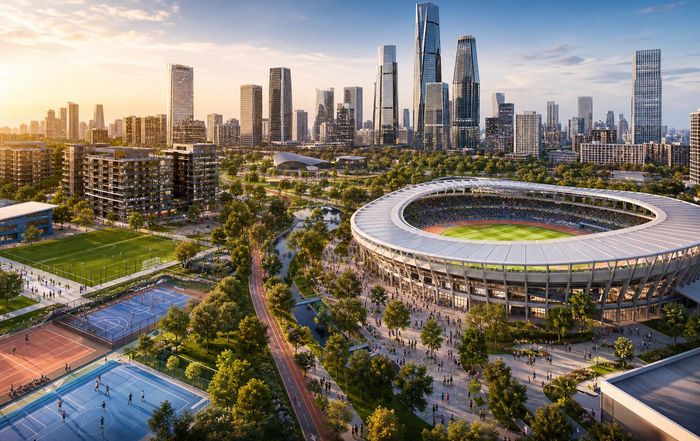
Historically, stadiums were often built as standalone monuments on the urban fringe, surrounded by parking lots and disconnected from daily city life. In 2026, the dominant model has shifted toward integrated sports and entertainment districts designed to function as active urban spaces seven days a week. Projects around Tottenham Hotspur Stadium in London, SoFi Stadium in Los Angeles, and Allianz Arena in Munich exemplify how clubs and developers are working with city governments to embed venues into mixed-use environments that support retail, dining, offices, housing, and public plazas.
Urban planners, drawing on guidance from organizations such as C40 Cities and ICLEI, increasingly insist on transit-oriented design, walkable streetscapes, and high environmental performance standards for sports infrastructure. Those interested in the technical side of sustainable urban design can review how C40 Cities describes climate-resilient development. These principles are now being adapted into stadium design, with features such as green roofs, integrated public transport hubs, and energy-efficient systems becoming standard expectations rather than premium add-ons.
On Sportsyncr, the evolution of stadiums from isolated venues into dynamic urban anchors is increasingly covered not only as a sports story but also as a technology and culture narrative, because these spaces now host esports, concerts, festivals, and community programming that blur the lines between physical and digital experiences.
Health, Fitness, and the Active City Paradigm
The global surge in health and fitness consciousness has had a profound influence on how cities incorporate sports into their development strategies. Public health agencies and organizations such as the World Health Organization have long emphasized the role of physical activity in reducing non-communicable diseases, and their guidance on health-promoting urban environments has informed municipal policies worldwide. As a result, cities from Copenhagen to Vancouver now embed active mobility, recreation spaces, and community sports facilities into master plans as essential infrastructure rather than optional amenities.
The "active city" paradigm emphasizes everyday movement: running trails integrated into waterfronts, cycling superhighways connecting residential districts to business hubs, and multi-use sports courts in dense neighborhoods. These features are seen as critical to improving quality of life, attracting skilled workers, and lowering long-term healthcare costs. Readers exploring top health-focused content on Sportsyncr will recognize how this shift ties sports participation directly to urban wellbeing and economic competitiveness, especially in highly urbanized regions such as Europe, North America, and increasingly Asia-Pacific.
In parallel, the fitness industry has embedded itself into the urban fabric, with boutique studios, athletic clubs, and outdoor training zones becoming key components of mixed-use developments. Research from sources like the Global Wellness Institute, which tracks wellness economy trends, shows that wellness real estate and fitness amenities now significantly influence residential and commercial property values, reinforcing the strategic role of sports and fitness in city planning.
Social Cohesion, Identity, and the Cultural Power of Sport
Beyond economics and health, sports exert a powerful influence on the social and cultural dimensions of urban life. In cities with strong club traditions, such as Liverpool, Barcelona, Dortmund, or Buenos Aires, sports institutions function as anchors of local identity and intergenerational continuity. Sociologists and urban theorists, including those at LSE Cities, have explored how sports fandom and participation create shared rituals that bridge class, ethnicity, and age, contributing to a sense of belonging in increasingly diverse and mobile urban populations. Those interested in this dimension can examine how LSE Cities discusses urban identities and public space.
In 2026, this cultural power is being harnessed more deliberately in urban regeneration projects. Community clubs, fan-led initiatives, and non-profit organizations partner with city authorities to deliver youth programs, social inclusion projects, and cross-cultural events in and around sports facilities. This is particularly evident in neighborhoods undergoing rapid change, where sports can provide continuity and voice for long-standing communities. On Sportsyncr, coverage of social impact stories increasingly highlights how sports-based programs support integration of migrants, provide safe spaces for young people, and help cities manage tensions around gentrification and displacement.
At the same time, cities must navigate the risks of over-commercialization and cultural erasure, as traditional grounds and grassroots clubs sometimes give way to premium developments targeting global audiences rather than local residents. The tension between global brand-building and neighborhood authenticity is now a central theme in both urban policy debates and sports journalism, including across Sportsyncr's unaffiliated culture and brands coverage.
Global Events, Mega-Projects, and the Legacy Question
Mega-events such as the Olympic Games, FIFA World Cup, and continental championships have long been catalysts for large-scale urban transformation. As cities in the United States, Canada, Europe, Asia, and the Middle East prepare to host global tournaments through the 2020s and early 2030s, the debate over legacy has become more sophisticated and data-driven. Organizations such as the International Olympic Committee now publish detailed frameworks on sustainable Olympic legacy planning, emphasizing long-term community use of venues, integration with existing infrastructure, and environmental responsibility.
Cities like London (2012) and Barcelona (1992) are frequently cited as examples of how sports events can accelerate transport upgrades, waterfront regeneration, and housing development. More recent hosts have grappled with the challenge of avoiding white elephants and ensuring that investments in stadiums, athletes' villages, and media centers translate into enduring benefits. Analysts at institutions such as Brookings and Chatham House have examined how mega-events intersect with urban governance, geopolitics, and economic strategy, offering cautionary lessons for future hosts. Those wanting deeper insight into urban policy debates can explore how Brookings addresses cities and global events.
For Sportsyncr, whose loyal readers follow both news and long-term trends, the legacy question is central to evaluating whether sports-driven urban development genuinely serves citizens or primarily benefits short-term political and commercial interests. Coverage increasingly scrutinizes how host cities manage displacement, cost overruns, and post-event utilization, and how they incorporate community voices into planning processes.
Technology, Data, and the Smart Sports City
Technological innovation is reshaping the relationship between sports and urban systems in ways that would have been difficult to imagine a decade ago. Smart stadiums equipped with advanced connectivity, sensor networks, and digital twin models now function as testbeds for broader smart city applications, from crowd management and mobility optimization to energy efficiency and security. Organizations such as the Smart Cities Council and IEEE document how urban digital infrastructure supports real-time decision-making and enhances the visitor experience, while raising questions about data governance and privacy.
In cities such as Tokyo, Seoul, and Singapore, integrated mobility platforms use live data from public transport, ride-hailing, and micromobility providers to coordinate flows to and from major sports venues, reducing congestion and emissions. Those interested in the broader context can see how Singapore's government presents its Smart Nation vision, which includes applications in events and transport that are directly relevant to large sports gatherings. Inside stadiums, technology from companies like Cisco, IBM, and SAP powers in-venue analytics, personalized services, and dynamic pricing models that influence not only fan engagement but also local retail and hospitality patterns.
This convergence of sports and urban technology is a central editorial theme, connecting recent technology coverage with reporting on fan experience, cybersecurity, and the changing economics of live events. As esports and gaming arenas become fixtures in urban entertainment districts, the line between sports technology and broader digital culture continues to blur, reflecting the interests of younger, globally connected audiences.
Environmental Sustainability and Climate-Resilient Sports Infrastructure
Climate change has forced city leaders and sports organizations to rethink how venues are designed, built, and operated. Extreme heat, flooding, and air quality issues increasingly affect training schedules, competition calendars, and fan attendance across continents. Environmental groups and research institutions, including the Intergovernmental Panel on Climate Change (IPCC), have highlighted the vulnerability of sports infrastructure to climate risks, while also noting the sector's significant carbon footprint. Those seeking to understand the science underpinning these concerns can review IPCC's climate reports.
In response, new stadiums and training centers are being constructed with stringent sustainability criteria: renewable energy systems, water recycling, low-carbon materials, and integration with green transport networks. Certification frameworks like LEED and BREEAM are now commonly applied to major sports projects in the United States, Europe, and parts of Asia-Pacific, providing standardized benchmarks for environmental performance. Organizations such as Green Sports Alliance share best practices and case studies on sustainable sports venues, influencing both club owners and municipal planners.
On Sportsyncr, the environmental dimension is not treated as an afterthought; it is a core part of environment-focused reporting, examining how clubs, leagues, and host cities align climate commitments with fan expectations and commercial realities. As global audiences become more environmentally aware, the reputational risks of neglecting sustainability in sports-led urban development are growing, particularly for brands and cities positioning themselves as forward-looking and responsible.
Labor, Skills, and the Changing Sports Urban Workforce
Sports-driven urban development also reshapes labor markets and skills demand, from construction and event operations to data science, media, and hospitality. Large sports and entertainment districts generate thousands of jobs, many of them entry-level roles that provide pathways into the urban service economy. At the same time, the integration of advanced technology, analytics, and digital content production has created new professional profiles, particularly in cities with strong sports tech ecosystems such as San Francisco, Berlin, and Bangalore.
Labor economists and policy analysts point out that the quality and stability of these jobs vary widely. Ensuring that sports-led growth contributes to inclusive urban development requires deliberate strategies in training, wage standards, and local hiring. Organizations like the International Labour Organization (ILO) provide guidance on decent work in service economies, which is increasingly relevant as cities negotiate with clubs, leagues, and private developers on community benefit agreements.
For Sportsyncr, which covers jobs and careers in the sports ecosystem, this evolving labor landscape is a critical story. The platform's audience is increasingly interested not only in elite athletes and front-office executives but also in the broader workforce that sustains sports-centered urban economies, from coaches and content creators to sustainability managers and fan experience designers.
Global Perspectives: Regional Models of Sports-Led Urban Development
Although the underlying dynamics are global, regional differences shape how sports influence urban development in practice. In North America, franchise-based leagues and privately financed stadiums often drive city negotiations around tax incentives, infrastructure commitments, and community benefits, with examples ranging from Las Vegas to Toronto. In Europe, where clubs are deeply embedded in local culture and often operate within more stringent planning regimes, there is typically greater emphasis on heritage, fan ownership, and integration with existing urban fabric.
In Asia, rapid urbanization and state-led development models have produced ambitious sports cities and mega-complexes, particularly in China, Qatar, and Saudi Arabia, where sports investment is tied to broader diversification and soft power strategies. Observers can track these trends through organizations such as OECD, which analyzes regional urban development patterns, providing comparative insights into governance, financing, and social outcomes.
For Africa and South America, where urbanization is accelerating and fiscal constraints are significant, the challenge is to leverage sports for inclusive growth without overextending public finances or neglecting essential services. Grassroots initiatives, community clubs, and low-cost multi-sport facilities often play a more prominent role than mega-stadiums, and these models are increasingly recognized as viable pathways to healthier, more cohesive cities. On Sportsyncr, important world coverage increasingly highlights these diverse approaches, reflecting the platform's global readership across Europe, Asia, the Americas, Africa, and Oceania.
The Role of Brands and Sponsorship in Shaping Urban Sports Landscapes
Brands and sponsors have become powerful actors in the urban sports ecosystem, influencing not only the financial viability of venues and events but also the design and programming of public spaces. Naming rights deals, branded fan zones, and corporate-funded community facilities are now standard features of major sports developments in cities such as New York, Paris, Munich, and Tokyo. Marketing and sponsorship agencies, working with global corporations like Nike, Adidas, Coca-Cola, and Emirates, see urban sports environments as premium platforms for experiential engagement.
Organizations such as World Federation of Advertisers (WFA) and European Sponsorship Association (ESA) have documented the shift toward purpose-driven sponsorship, where brands are expected to contribute to social and environmental goals in host communities. Those interested in the evolving sponsorship landscape can explore how ESA discusses trends in sponsorship and community impact. As a result, sponsorship agreements increasingly include commitments to grassroots programs, inclusive design, and sustainable operations.
For Sportsyncr, which devotes dedicated coverage to brands and sponsorship, these developments are central to understanding how commercial strategies intersect with urban policy. The platform's analysis often focuses on whether brand involvement enhances or distorts local priorities, and how communities can negotiate partnerships that align corporate objectives with long-term public value.
Thinking To The Future! Big Needs for Cities and Stakeholders
As cities worldwide continue to harness sports as a catalyst for modern urban development, several strategic imperatives are emerging that will shape the next decade. First, integrated planning is essential; sports infrastructure must be conceived not as isolated projects but as components of broader transport, housing, environmental, and economic strategies. Second, meaningful community engagement is no longer optional; cities that neglect the voices of residents, fans, and local businesses risk social backlash and loss of trust, particularly in an era of heightened public scrutiny and digital activism.
Third, sustainability and resilience must be embedded from the outset, with climate, health, and social equity objectives clearly articulated and monitored over time. Fourth, the governance of data and technology in sports venues and districts requires robust frameworks to protect privacy, ensure cybersecurity, and prevent exclusion. Finally, there is a growing recognition that success should be measured not only in financial returns or visitor numbers but also in long-term contributions to public health, social cohesion, and cultural vitality.
For Sportsyncr, these needs define the editorial lens through which sports and urban development will be covered in the years ahead. By connecting sports, fitness, health, business, and culture reporting into a single narrative each day, the platform is positioned to help its global audience understand not only who wins on the field, but also how those victories and venues reshape the cities in which they live, work, and play.