

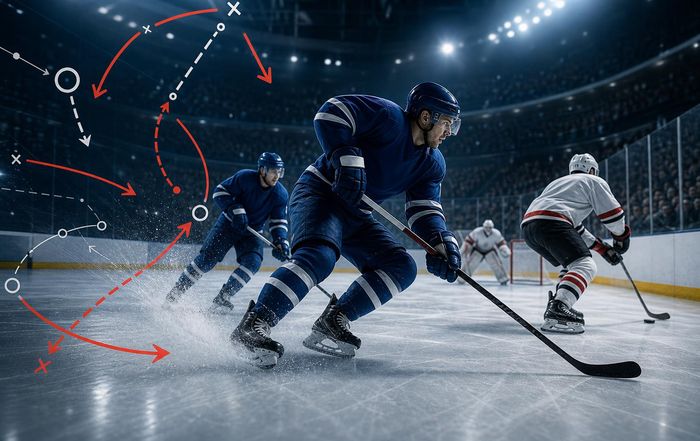
Ice Hockey Forechecking Strategies Explained
Forechecking sits at the heart of modern ice hockey. It is the moment a team loses the puck and decides not to retreat, but to pressure immediately in the offensive zone to win it back, slow the breakout, or force a turnover into a scoring chance. Whether it is a junior side learning structure or an NHL contender fine-tuning special teams, forecheck strategy largely determines how a team defends, how it attacks, and how it manages risk.
This guide breaks down the major forechecking systems, what they are trying to accomplish, how they differ across leagues and levels, and how coaches and players can choose and adjust the right approach. It is written for readers who already understand basic hockey positions and rules, but want to go deeper into tactics and game management.
What forechecking is really trying to achieve
At its core, forechecking is the organized pressure a team applies in the offensive zone when it does not have the puck. It begins the instant possession changes and usually continues until the defending team either exits the zone with control, ices the puck, or the forechecking team recovers possession.
Most forechecking systems try to balance three goals:
Regain the puck in dangerous areas. The ideal outcome is a turnover below the tops of the circles, where a quick pass or shot can turn pressure into a high-quality scoring chance. Many analytics groups, including those featured by the NHL on NHL.com, have shown that shots off offensive-zone turnovers carry a higher probability of becoming goals than shots off controlled entries.
Disrupt the breakout and slow the rush. Even if the forecheck does not create an immediate chance, it can force the opponent into soft clears, rim-arounds, or chip plays that are easier for the defense to handle. A good forecheck can feed into a strong neutral-zone structure, something national federations like Hockey Canada and USA Hockey emphasize in their coaching resources on hockeycanada.ca and usahockey.com.
Protect against counterattacks. Every extra skater committed deep in the offensive zone increases the risk of an odd-man rush against. Coaches therefore choose systems that fit their roster's skating ability, defensive awareness, and goaltending, aiming to apply enough pressure to be effective without giving up repeated 2-on-1s and breakaways.
On top of these core goals, forechecking also shapes a team's identity. High-pressure systems create a relentless, high-tempo feel that can energize fans and fit organizations that value pace and aggression. More conservative systems can suit older rosters, teams with elite goaltending, or clubs that rely on structure over chaos. For readers interested in how tactics intersect with culture and business, this is where team identity, branding, and roster construction meet the Xs and Os that decide games, a connection often explored in sports-business coverage on sites like The Athletic and ESPN.
Key principles that apply to every forecheck
Regardless of the specific system, successful forechecking relies on a few shared principles that coaches at all levels stress:
First, speed to pressure is non-negotiable. The first forechecker (often labeled F1) must close on the puck carrier quickly enough to remove easy options. Even a passive system becomes dangerous if the first skater arrives on time and angles correctly. NHL and international video breakdowns, including those highlighted by the IIHF at iihf.com, repeatedly show that the timing of F1 is the single biggest factor in whether a forecheck succeeds.
Second, support and layers matter more than raw aggression. F2 and F3 must read off F1, arriving not just fast, but in the right lanes to cut off passes and be ready to recover the puck. Defensemen must hold smart gaps, staying close enough to keep plays alive at the blue line without getting caught behind opposing forwards. Many coaching manuals, including those from USA Hockey, talk about "staggered" support: one player pressuring, one reading the next pass, and one covering the middle.
Third, stick positioning and body angle are as important as physical contact. A good forechecker does not simply chase; they steer the puck carrier toward the boards or into a pre-planned trap. Elite teams often talk about "funneling" the play into certain areas, using their sticks to take away the middle of the ice and force low-percentage options.
Fourth, communication is critical, especially in loud arenas and high-speed situations. Defensemen call switches, forwards communicate which side is "on" (strong side) and which is "off," and lines must recognize when to stay aggressive and when to fall back into the neutral-zone structure. This is one reason veteran centers often act as on-ice extensions of the coaching staff.
Finally, discipline and line management tie the system together. A high-tempo forecheck is punishing physically. Conditioning and recovery, topics often covered in performance-focused outlets like Sports Science Lab and mainstream coverage at BBC Sport, matter because tired legs destroy timing and turn aggressive systems into defensive liabilities.
For readers who want to connect these tactical ideas with broader performance and health topics, our own sections on fitness and health regularly explore how training, recovery, and workload management underpin on-ice strategy.
The 1-2-2 forecheck: The modern default
The 1-2-2 forecheck is the most widely used base system in pro and elite amateur hockey. The numbers describe how many forwards are committed to each "layer" of the ice: one deep, two in the middle, and two defensemen high.
In a classic 1-2-2, F1 drives in first to pressure the puck carrier or the first touch after a dump-in. Their job is to force play one way, ideally toward the boards on the strong side. F2 and F3 then read the play from slightly higher in the zone. One usually supports F1 on the strong side, ready to jump loose pucks or cut off the wall breakout; the other shades toward the middle, protecting the slot and reading any D-to-D pass or attempted escape through the center. The two defensemen hold the blue line, pinching down the boards when safe while one stays more central as a safety valve.
Teams can vary how aggressive this structure becomes. An "aggressive 1-2-2" sees F2 press down almost as quickly as F1, with the strong-side defenseman pinching hard on any chipped puck. This style can trap opponents in their own end for extended shifts, something fans see frequently from high-tempo NHL clubs and top European sides. A "conservative 1-2-2" keeps F2 and F3 higher, focusing on intercepting passes and forcing dump-outs rather than hunting for turnovers below the goal line.
The 1-2-2's main strengths are its balance and flexibility. It allows quick transitions into neutral-zone formations like the 1-1-3 or 1-3-1, and it can be adjusted game-to-game depending on opponent tendencies. It also scales well across levels: many youth and junior coaches use a simplified 1-2-2 as a teaching tool before introducing more complex pressure schemes, a progression reflected in coaching materials from organizations such as Hockey Canada and USA Hockey.
However, the 1-2-2 can be vulnerable if F1 arrives late or is beaten cleanly. If the first layer fails, the system can collapse into a scrambling chase, particularly if F2 and F3 have already committed downward. Opponents with mobile defensemen and strong support from their centers can sometimes pass through the middle layer and exit with speed, turning the forecheck's aggression into a liability. This is why video analysis, increasingly supported by tracking technology from companies like Sportlogiq and league-driven initiatives highlighted by NHL.com, has become central to fine-tuning how and when teams deploy the 1-2-2.
For broader tactical context on how the 1-2-2 fits into modern systems across sports, readers may find our sports and technology sections useful, where we often cover tracking data, analytics, and coaching trends.
The 2-1-2 forecheck: High-pressure, high-risk hockey
The 2-1-2 forecheck is the most aggressive mainstream system, often associated with "heavy" teams that want to wear opponents down physically. Here, two forwards (F1 and F2) drive deep almost simultaneously, pressuring the puck carrier and the nearest support option, while F3 stays higher in the middle, reading the play and guarding against quick breakouts.
In its most attacking form, F1 finishes every check, aiming to separate the puck from the defender. F2 arrives a half-step later, ready to jump on loose pucks or cut off the reverse. F3 hovers around the tops of the circles, prepared to jump into the slot if a turnover occurs or retreat quickly if the breakout beats the first two. The defensemen hold an aggressive gap at the blue line, pinching whenever they read soft plays up the wall.
The upside is obvious: sustained offensive-zone time and a stream of turnovers in dangerous areas. Analytics-focused sites like Evolving-Hockey and Natural Stat Trick have repeatedly shown that teams generating repeated offensive-zone recoveries tend to dominate expected goals and shot share. A well-executed 2-1-2 can trap opponents for long shifts, drawing penalties and creating fatigue-driven mistakes.
The downside is equally clear. If the opponent breaks the first layer with a clean pass or a well-timed reverse, the forechecking team may suddenly find only three players above the puck: F3 and the two defensemen. If one defenseman has pinched and the puck gets past them, the result can be an odd-man rush. This risk is magnified against mobile, puck-moving defenses and speedy wingers, a dynamic that has shaped how some NHL and European teams adjusted their systems as the game has become faster.
Coaches often reserve the pure 2-1-2 for specific situations: trailing late in a game, facing a tired opponent, or targeting a defensive pair that struggles under pressure. Some clubs build their identity around it, but even those tend to dial the pressure up and down depending on game state and opponent. For a broader perspective on how tactical risk profiles tie into club strategy and roster decisions, our business coverage often looks at how front offices align playing style with recruitment and cap management.
The 1-1-3 and 1-3-1: Trap-influenced forechecks
While the term "trap" is often associated with neutral-zone systems, certain forechecks blur the line between offensive-zone pressure and neutral-zone clogging. The 1-1-3 and 1-3-1 structures are good examples, and they have seen renewed interest as teams search for ways to slow high-speed breakouts without conceding too much offensive pressure.
In a 1-1-3, F1 pressures the puck carrier deep, but F2 stays higher, often around the tops of the circles, acting as a "free safety" in the middle of the ice. Behind them, three skaters (usually F3 and the two defensemen) form a horizontal line across the ice between the red line and defensive blue line, ready to step up on any pass or carry attempt. If the opponent breaks past F1, they immediately run into a wall of three.
The 1-3-1 is even more conservative. F1 still applies initial pressure, but three skaters line up across the neutral zone, with one player (often a defenseman or center) trailing deeper as a safety. These systems are not pure offensive-zone forechecks, but many teams flow into them after an initial pressure attempt. For example, if F1 forces an early pass and the opponent starts up ice, the forechecking team quickly pulls back into a 1-3-1 wall.
The strength of these approaches is control. They limit odd-man rushes, slow the game down, and force opponents to dump pucks or attempt low-percentage passes through traffic. They are particularly useful for underdogs trying to neutralize more skilled opponents, or for teams protecting a lead. Internationally, versions of these structures have been used by national teams in high-stakes tournaments, as documented in coaching analyses shared by the IIHF and various national federations.
The trade-off is that they cede some offensive-zone time. Because fewer forwards commit deep, there are fewer bodies around the puck to create immediate turnovers. Fans who prefer up-tempo, forecheck-heavy hockey sometimes find these systems less entertaining, a tension that has periodically fed into discussions about rule changes and officiating standards on platforms like ESPN and TSN.
From a development standpoint, some coaches introduce elements of the 1-1-3 and 1-3-1 at older age groups or higher competition levels, once players have mastered more basic pressure systems. The systems demand strong positional awareness and communication, tying into the broader strategic education that many federations, including Hockey Canada and USA Hockey, are trying to foster.
The 2-3 and swarm-style forechecks: Situational weapons
Less common but still important are 2-3 and various "swarm" forechecks, which commit extra bodies high in the zone to choke off exits. These systems are often used situationally rather than as full-time identities.
In a 2-3 look, two forwards drive deep, much like in a 2-1-2. Instead of F3 staying high in the middle, however, all three remaining skaters (F3 and both defensemen) hold the blue line relatively tight, pinching aggressively on any attempt to exit along the boards. The goal is to lock the puck in the zone and create extended siege-style pressure. This can be especially effective on small rinks or against teams that rely heavily on glass-and-out clears.
"Swarm" concepts, sometimes used at youth levels or in short-handed situations, see multiple skaters collapse toward the puck side, overwhelming the puck carrier with numbers. The downside is that the weak side of the ice can be left dangerously open if the opponent escapes the initial pressure, something that more advanced teams quickly exploit.
Because these systems are so aggressive, they are often reserved for late-game situations, power plays that bleed into 5-on-5, or targeted matchups where a coaching staff has identified a particular weakness. They can also be useful tools for changing momentum: a team that has been on its heels may briefly adopt a more aggressive forecheck to jolt itself into the game.
For readers who enjoy following tactical wrinkles and coaching gambits, our news and world sections frequently cover how different leagues and national teams experiment with systems, influenced by analytics, player profiles, and even broader trends in sports science and technology.
Adapting forecheck strategy to league, roster, and game state
No forechecking system exists in a vacuum. Coaches constantly adapt their approach to the league they play in, the roster at their disposal, and the specific situation in a game or series.
League context matters because rink dimensions, officiating standards, and scheduling all influence how much pressure a team can sustain. European leagues with larger ice surfaces, many of them under the IIHF umbrella at iihf.com, often emphasize controlled pressure and strong neutral-zone structure, because the wider rink makes all-out swarms easier to bypass. North American leagues with smaller rinks and more frequent games may lean more heavily on systems that distribute the workload and protect against fatigue-related breakdowns.
Rosters drive decisions as well. A team with fast, tenacious wingers and mobile defensemen might happily lean into a 2-1-2 base, trusting its speed to recover if plays break down. Clubs with bigger, heavier forwards who excel at board battles might prefer an aggressive 1-2-2 that funnels play to the walls, where they can grind opponents down. Teams built around elite goaltending sometimes accept more conservative forechecks, confident that their netminder will handle the lower-quality chances that come from a more controlled pace.
Game state and score also shape forecheck choices. Trailing teams often ramp up pressure, moving from a 1-2-2 to a 2-1-2 or more aggressive pinches to chase a tying goal. Leading teams may shift into a 1-1-3 or 1-3-1 look to protect the middle of the ice and limit rush chances. These adjustments are increasingly data-informed: front offices and coaching staffs use tracking data and analytics, often produced by specialized firms and analyzed by outlets like The Athletic, to understand which systems perform best in different situations.
For those interested in how this data-driven evolution intersects with broader technology and business trends in sport, our technology and business coverage regularly explores how clubs invest in analytics infrastructure and how those investments shape on-ice decisions.
Teaching and learning forechecking at different levels
At the grassroots and development levels, forechecking is both a tactical and educational tool. Coaches use simple systems to teach spacing, communication, and responsibility, then layer complexity as players advance.
Younger age groups often start with a basic 1-2-2 or even a "1-1-2" concept, where one player pressures the puck, one supports in the middle, and two stay high. The focus is less on perfect structure and more on teaching players not to chase the puck aimlessly. National governing bodies such as USA Hockey and Hockey Canada provide age-appropriate progressions on usahockey.com and hockeycanada.ca, emphasizing concepts like angling, stick positioning, and support before introducing full-blown systems.
At junior, collegiate, and pro levels, video becomes central. Teams break down how opponents exit their zone, which defensemen struggle under pressure, and where passing lanes typically open. Players study their own tendencies as well, learning when they over-commit or leave gaps. This is where the intersection of sport and technology becomes especially visible, with tracking systems, tablets on benches, and post-game analytics sessions now routine in many top programs.
For individual players, understanding forechecking is also about role clarity. Wingers must know their responsibilities as F1, F2, or F3 depending on where they are on the ice when the puck turns over. Centers need to read the play and often act as the extra layer of support, filling holes when a defenseman pinches or when a winger gets caught deep. Defensemen must master when to pinch, when to hold, and how to manage their gap in a way that supports the system rather than undermines it.
Readers interested in how these tactical lessons overlap with broader performance, coaching careers, and even job opportunities in sports analytics and coaching can explore our jobs and science sections, where we often highlight the growing professional ecosystem around high-performance sport.
Why forechecking strategy matters more than ever
As ice hockey continues to evolve-driven by changes in rules, officiating standards, analytics, and player development-forechecking has become even more central to how teams create advantages. The speed of the modern game means that small edges in timing, structure, and decision-making can swing playoff series and international tournaments.
Teams that master multiple forechecking systems and can switch between them fluidly pose a constant puzzle for opponents. Clubs that cling rigidly to a single approach risk being "solved" by analysts and coaching staffs who understand how to exploit specific weaknesses. This dynamic, where on-ice tactics and off-ice analysis push each other forward, is part of what makes contemporary hockey so compelling for fans who enjoy both the physical spectacle and the strategic chess match.
For players and coaches, understanding forechecking is no longer optional; it is a core competency that underpins both offensive creation and defensive solidity. For fans, learning how different systems work can make watching games richer and more engaging. Recognizing when a team shifts from a 1-2-2 to a 2-1-2, or spotting a late-game move into a 1-3-1 wall, adds new layers to the experience, much as understanding formations enhances the viewing of football or basketball.
As with many aspects of sport, the best way to deepen that understanding is to combine watching live or broadcast games with thoughtful analysis from trusted sources. Official league platforms like NHL.com, national federation resources at usahockey.com and hockeycanada.ca, and independent coverage from outlets such as The Athletic, ESPN, and BBC Sport all offer different perspectives on how forechecking strategy is evolving.
For those who want to connect that tactical knowledge with broader themes from fitness and health to business, culture, and technology, our daily original reporting across sports, fitness, health, business, and technology continues to follow how the forecheck, and the game around it, keeps changing.