

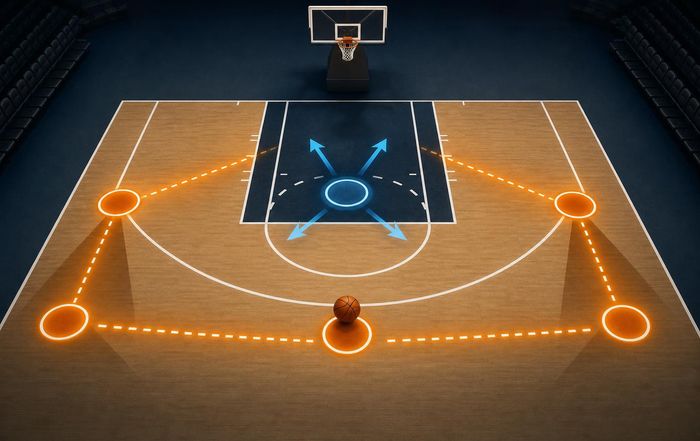
Why Spacing Decides Everything in a Half-Court Basketball Offense
In modern basketball, from youth leagues to the NBA, almost every coach talks about "spacing." It shows up in playbooks, scouting reports, and film sessions, yet it is often reduced to a vague instruction: "Spread out!" In reality, spacing is a precise, teachable concept that underpins almost every successful half-court possession. Whether a team prefers motion offense, pick-and-roll, post-ups, or five-out flow, the geometry of where players stand and move is what turns actions into advantages and advantages into points.
This article looks at why spacing matters so much in half-court offense, how elite teams create it, the common mistakes that destroy it, and how players and coaches at different levels can train it. Along the way, it connects tactical ideas to physical performance, analytics, and even the business of the sport, showing why spacing is no longer just a coaching buzzword but a competitive necessity.
What "Good Spacing" Actually Means
At its core, spacing is the distribution of offensive players on the floor so that the defense is stretched as far and in as many directions as possible without compromising the timing of the offense. Instead of clustering near the ball, well-spaced players occupy spots that force defenders to make difficult choices: help on the drive and give up a shot, or stay home and surrender a lane to the rim. This is why coaches talk about "playing in space" rather than simply "spreading out."
Most professional and top-level collegiate teams build their spacing around concepts like four-out one-in, five-out, or "horns" alignments. The exact structure varies, but the principle is similar: maintain proper distance between teammates (often in the range of 15-20 feet), balance both sides of the floor, and ensure that at least two or three credible shooters are positioned behind the three-point line. Organizations such as the NBA and EuroLeague have published breakdowns and analytics showing how three-point shooting and driving lanes are directly tied to where offensive players stand and how frequently they relocate, underscoring that spacing is not just visual aesthetics but measurable impact.
For readers new to tactical breakdowns, it can help to think of spacing like a well-designed offense in American football or a structured attack in soccer: the ball may be central to the action, but the real danger comes from how the other players position themselves to stretch the defense horizontally and vertically. In basketball, because the space is smaller and the game faster, small spacing errors-one player cutting five feet too close, or a big man lingering in the lane-can collapse an entire possession.
How Spacing Creates Driving Lanes and Rim Pressure
In half-court offense, the most efficient shots are typically at the rim and free throws, followed closely by open three-pointers. Data from advanced analytics groups like Second Spectrum, Synergy Sports, and league offices such as the NBA and WNBA consistently show that drives to the basket produce high-value outcomes when supported by good spacing. When the floor is spread, the ball handler faces fewer help defenders and can attack closeouts or mismatches more aggressively.
Imagine a simple pick-and-roll at the top of the key. If three teammates are bunched near the strong side, their defenders can shrink into the paint while still recovering to shooters, effectively building a wall in front of the ball. Conversely, if those teammates are spaced to the corners and weak-side wing, their defenders must cover significantly more ground to help and then recover. This extra distance buys the ball handler fractions of a second, which at elite speed often decides whether a drive reaches the rim or gets stalled at the free-throw line.
Spacing also dictates how much "rim pressure" a team can apply over the course of a game. Rim pressure is not just about individual athleticism; it is about whether there is enough room to attack again and again without running into a crowd. Teams that consistently force defenses into rotation generate more fouls, more drop-offs to bigs, and more kick-out threes. For readers interested in how this translates statistically, many public analytics sites like Basketball-Reference and Cleaning the Glass (subscription-based) track drive frequency, paint touches, and shot quality, all of which correlate strongly with effective spacing.
The connection to performance and health is also notable. When lanes are open, players can make more direct, controlled movements instead of repeatedly jumping into traffic or contorting mid-air to avoid help defenders. From a sports science perspective, as covered by organizations like FIBA and research hubs linked via platforms such as Google Scholar, better spacing can reduce the number of high-impact collisions and awkward landings that accumulate over a season.
Why Spacing Supercharges Passing and Playmaking
While spacing is often discussed in terms of drives, it is equally critical for passing. A well-spaced offense offers multiple passing angles and clear sight lines, allowing playmakers to read the floor more quickly and accurately. Watch high-level teams that emphasize ball movement-many European clubs, top NCAA programs, and motion-heavy NBA offenses-and the pattern is obvious: as the ball moves, so do the players, constantly lifting, sliding, and cutting to maintain optimal gaps.
When two offensive players stand too close, their defenders can guard both with minimal movement, effectively creating a "2-for-1" advantage for the defense. Proper spacing reverses this equation: one offensive player forces one defender to commit, leaving someone else momentarily open. The best offenses chain these small advantages together until the defense finally breaks. This is why coaches often say, "The ball finds energy"-in a well-spaced offense, quick passes to open teammates are rewarded because each pass forces the defense to rotate and chase.
Good spacing also makes it easier to leverage different offensive roles. A non-shooter who understands spacing can still be valuable by cutting through the lane at the right time, screening away from the ball, or occupying the dunker spot (the short corners near the baseline) in a way that punishes over-help. Many developmental programs and national federations, including those highlighted by USA Basketball and Basketball England, emphasize teaching young players how to fill spots, clear space, and move without the ball, not just how to dribble and shoot. The message is clear: passing and playmaking are only as effective as the space they operate in.
The Three-Point Line, Analytics, and the Evolution of Spacing
The rise of three-point shooting has fundamentally reshaped half-court spacing. As teams across the NBA, WNBA, and major international leagues embraced analytics, they discovered that three-point attempts, especially from the corners and off drive-and-kick actions, could dramatically increase offensive efficiency. This led to a strategic shift: instead of packing the lane with multiple bigs, coaches began to favor lineups with four or even five players who could stretch the floor.
Analytics-driven organizations and data providers like NBA.com, ESPN, and FiveThirtyEight have documented how offenses that generate a high volume of threes-particularly wide-open ones-tend to score more points per possession. But the key detail is often misunderstood: the goal is not simply to shoot more threes; it is to use spacing to create better threes. A contested three early in the clock is rarely as valuable as an open one generated after a drive, kick, and extra pass.
This evolution has also changed how big men are used. Traditional back-to-the-basket centers now often operate as pick-and-roll finishers, high-post facilitators, or even as stretch bigs who can hit from beyond the arc. Their ability to pull rim protectors away from the basket opens up cutting lanes and short rolls, where they can either score or connect passes to corner shooters. The "five-out" offense, once seen mainly in youth or small-ball lineups, has become a staple for professional teams that want constant driving lanes and dynamic ball movement.
For fans and analysts following the sport, this shift has influenced everything from player scouting to contract values and sponsorship narratives. Floor-spacing forwards and guards who can defend multiple positions are now among the most sought-after profiles, shaping how franchises allocate salary cap space and how brands position athletes as modern, versatile stars.
Common Spacing Mistakes That Kill Half-Court Offense
Even at high levels, poor spacing can derail possessions and neutralize individual talent. One of the most frequent issues is "gravity stacking," where two or three capable shooters drift into the same area, such as the strong-side wing and corner. On paper, stacking shooting threats sounds appealing, but in practice it allows the defense to shrink the floor and stunt at drives while still contesting shots. Smart defenses, including those in top European leagues and international competitions governed by FIBA, are trained to load up on the ball side when the offense fails to balance the floor.
Another common error is the big man camping in the lane for too long. Beyond the obvious risk of a three-second violation in leagues that use that rule, a stationary interior player clogs driving lanes and makes it easier for help defenders to tag rollers and cutters. Modern offenses often ask bigs to "dunk-in" (duck into the post) only after the ball has created an advantage, not as a starting point. If the ball handler cannot see daylight because a teammate is standing at the rim, the action has effectively self-destructed.
Timing errors also undermine spacing. For example, a cutter who drives into the lane just as a teammate is attacking off a ball screen can bring an extra defender into the play, turning a potential 2-on-1 into a congested mess. Similarly, players who fail to "lift" from the corners or "drift" to open space when the ball penetrates make it easier for defenders to help and still recover. These issues are why many coaches use film breakdowns, sometimes with tools highlighted by outlets like Sports Illustrated and The Athletic, to show players not just where they were standing but when they moved relative to the ball.
For developing players, it can be tempting to blame missed shots or turnovers on skill alone. However, a surprising number of bad possessions in youth, high school, and even college basketball trace back to spacing breakdowns rather than poor shooting form or ball-handling. Recognizing this helps coaches allocate practice time more effectively, balancing individual skill work with conceptual team offense.
Teaching and Training Spacing: From Youth to Pro
Spacing is both a concept and a habit, which means it must be taught explicitly and then reinforced through repetition. Many national federations, including USA Basketball and Basketball Australia, stress games-based drills rather than static pattern memorization. Small-sided games such as 3-on-3 or 4-on-4 on a half-court force players to read help defenders, fill open spots, and maintain distance under pressure.
Coaches often start with simple positional rules: corners must be filled, the weak-side wing must stay lifted, and the ball handler should have at least two passing outlets. From there, they add layers: drive-and-kick rules (e.g., "if your defender helps, you drift or replace"), screen-and-roll spacing (e.g., "strong-side corner stays, weak-side wing lifts"), and post-up spacing (e.g., "if the ball goes in, we cut and clear the strong side"). By embedding these rules into continuous drills, players learn to adjust on the fly rather than relying on memorized plays that break down at the first defensive switch.
Technology also plays a growing role. Video platforms, tracking systems, and analytics dashboards-used across leagues and highlighted by organizations like NBA.com, FIBA, and various performance labs-allow coaches to show players heat maps of where shots are coming from, where turnovers spike, and how often they occupy the same spots. For serious athletes focused on performance and health, this data can be combined with conditioning and movement-efficiency work, aligning tactical understanding with physical readiness.
Readers interested in how this intersects with broader sports performance can explore topics like movement efficiency and injury prevention on health-focused resources, and then connect those ideas to basketball-specific training. Internal resources on fitness and health offer useful context on how strength, mobility, and conditioning support the demands of a spaced, up-tempo half-court game.
How Spacing Shapes Roles, Lineups, and Team Identity
Spacing is not just an X-and-O concept; it shapes roster construction, roles, and even a team's identity. Coaches increasingly think in terms of "spacing lineups" and "pressure lineups," deciding which combinations of players can keep the floor properly spread while still defending and rebounding. For example, a lineup with three elite shooters and two non-shooters may still function if the non-shooters are dynamic screeners and cutters who understand how to vacate space at the right moments. Conversely, a lineup with multiple hesitant shooters can grind an offense to a halt, no matter how talented the primary ball handler is.
Front offices and analytics departments, often covered in detail by business-oriented outlets like Forbes and Bloomberg, now evaluate players partly by their "gravity"-the degree to which defenders feel compelled to stay close to them even when they do not have the ball. A player with strong shooting percentages and a quick release forces defenders to hug them at the three-point line, effectively stretching the defense even if they take only a few shots per game. This invisible value shows up in lineup data and on/off metrics, influencing contract negotiations and strategic planning.
For fans and participants who track the sport beyond the court, this has ripple effects across the business and cultural sides of basketball. Teams that play an appealing, well-spaced style often draw higher viewership and sponsor interest, as the game looks faster, more open, and more skill-based. Those interested in broader sports business and sponsorship trends can find related coverage via business and sponsorship sections, where similar spacing-driven evolutions are visible in other sports and commercial strategies.
Defensive Adjustments and the Ongoing Spacing Battle
As offenses have become more spacing-conscious, defenses have adapted. Modern schemes feature aggressive closeouts, switching, and "scram" tactics designed to keep the ball in front while still contesting shooters. Teams study spacing tendencies and call out "no corner threes" or "weak-side nail help" to preemptively disrupt drive-and-kick sequences. Defensive coordinators, some of whom have been profiled by major outlets like The New York Times and BBC Sport, design coverages specifically to force offenses out of their preferred spots.
This has led to a constant chess match. Offenses respond by using ghost screens, Spain pick-and-rolls (with a back screen on the roller), and inverted actions where guards screen for bigs, all aimed at confusing defensive assignments and creating momentary spacing advantages. The best teams are not just well-spaced; they are unpredictable in how they arrive at that spacing. Instead of always starting in a static alignment, they flow into their structure through early offense, drag screens in transition, or quick handoffs that catch the defense mid-rotation.
For casual viewers, this can make the game look like free-flowing improvisation. But under the surface, both sides are engaged in a detailed spatial battle. Every cut, lift, and relocation is a response to where defenders are standing and how quickly they can cover ground. Understanding this makes watching high-level games more engaging: one can see how a single misstep-an over-help from the weak side, a late tag on the roller, or a failure to bump a cutter-creates a spacing breakdown that the offense exploits.
Fans interested in the global evolution of tactics can explore broader world and sports coverage, where similar spacing-and-structure battles appear in football, rugby, and even esports titles like basketball simulations and tactical games highlighted on gaming pages.
Practical Takeaways for Players, Coaches, and Fans
For players, the most actionable lesson is that spacing is a skill, not just a system. It involves constant awareness: Where is the ball? Where are my teammates? Where is the help defense? Am I making my defender's job easier or harder by where I stand? Developing this awareness can be as simple as using film review, asking coaches specific questions about positioning, and treating every drill as an opportunity to practice spacing habits-filling corners, lifting on drives, and avoiding crowding the ball.
Coaches at all levels can benefit from building spacing rules into their offensive philosophy rather than tacking them on later. Whether the team runs structured sets or a more free-flowing read-and-react system, clear guidelines about where players should be and how they should move when the ball drives, posts, or screens will prevent many of the breakdowns that lead to low-quality shots. Integrating these ideas with strength and conditioning plans, as covered in fitness and health resources, ensures that players have both the understanding and the physical capacity to execute.
For fans and analysts, recognizing the importance of spacing adds depth to how games are watched and discussed. Instead of focusing solely on whether a star "took over" or "disappeared," one can look at how often they had clean driving lanes, how many shooters were on the floor with them, and whether the offense maintained structure when plays broke down. This perspective aligns with broader sports analysis trends highlighted in news and science coverage, where data and tactical nuance increasingly inform how performance is understood.
In the end, half-court offense is less about memorizing plays and more about mastering space. Shooting, ball-handling, and athleticism still matter enormously, but they are amplified or muted by where players stand and how they move together. Teams that understand and value spacing turn the same 94 feet of hardwood into a much larger, more dangerous canvas-and in today's game, that often makes the difference between an average offense and an elite one.